

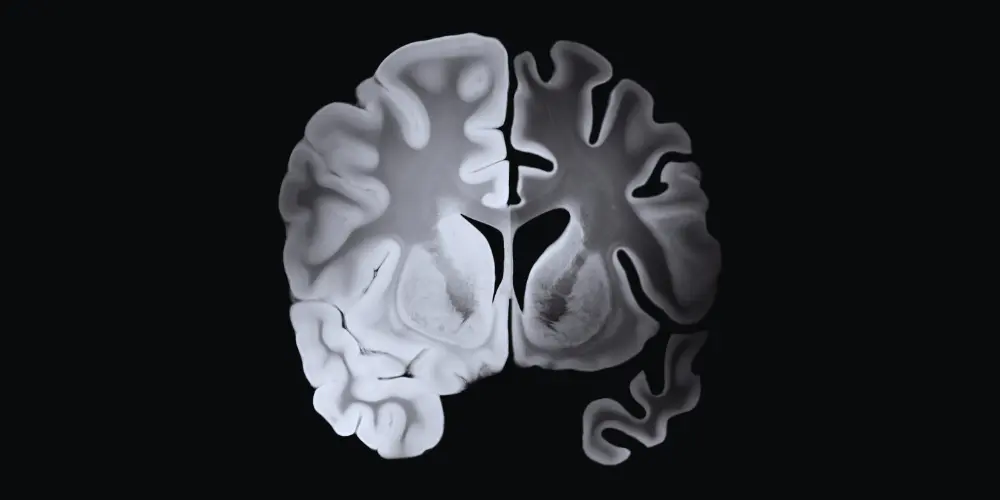
When do changes in the brain begin before an Alzheimer’s disease diagnosis? Dr. Jianrong Li, a professor and researcher at Texas A&M, is trying to find the answer.
Dr. Li’s study analyzes the brain’s support cells and myelin, pulling back the veil on genetic risk factors that may trigger early changes linked to Alzheimer’s. The Texas A&M University College of Veterinary Medicine and Biomedical Sciences (VMBS), where Dr. Li is a professor, has received a $2.17 million grant from the National Institute on Aging.
Li’s project pinpoints early brain changes that indicate a risk of Alzheimer’s disease – long before it is diagnosed – to help examine how the disease progresses.
Why does BIN1 matter in Alzheimer’s Disease?
It often takes visible symptoms to be diagnosed with Alzheimer’s disease, such as memory loss, which is why Dr. Li is working to recognize early risks and signs of progression.
“By the time Alzheimer’s disease is diagnosed, it is already late — significant changes have already occurred in the brain,” Li said. “That’s why we’re interested in early disease mechanisms and how the support system changes.”
Li’s team is focused on isolating how BIN1 affects myelin-producing cells at specific stages. That will allow scientists to better understand how disruptions in the brain’s support system may influence neurons long before widespread damage occurs.
BIN1, a multifunctional protein with a strong link to late-onset Alzheimer’s disease, works as a bridge inside cells to transport materials and maintain cell membrane structure. Late-onset Alzheimer’s is the most common form of this disease.
Large genetic studies have shown that people with certain changes in the BIN1 gene are at a much higher risk of developing Alzheimer’s disease later in life.
Despite BIN1’s strong link to Alzheimer’s disease, there’s a lack of information: scientists know relatively little about how the gene functions in myelin-producing cells. Li’s study aims to fill that gap by examining how changes in BIN1 affect myelin structure and axons. Axons are the long extensions of neurons allowing brain cells to communicate.
By studying BIN1 in oligodendrocytes rather than neurons, Li hopes to uncover and better understand how early damage to the brain’s insulation system may make neurons more susceptible to damage over time.
Learning how to protect axons and brain communication
Another major focus of the study is axon integrity, specifically, how healthy the axons are. Axons depend on myelin for protection and efficient signal transmission, meaning damage to that system could leave axons vulnerable.
“When axons degenerate, you lose synapses, which is how neurons communicate with each other,” Li said.
Loss of synapses disrupts communication in the brain. It is closely linked to cognitive decline. By examining how BIN1 affects myelin and axons together, Li aims to better understand how early changes in the brain’s support system may contribute to the breakdown of neural connections seen in Alzheimer’s disease.
Why is federal funding so important?
The size of the federal grant reflects just how urgent Alzheimer’s research is and the efficiency and thoroughness of Li’s approach. It’s a novel approach on a large scale that would not have been possible otherwise. It also takes precision.
“This work is novel and significant because myelin involvement in Alzheimer’s disease has not been well studied,” Li said.
Support from the National Institute on Aging allows Li’s team to use advanced models and tools to isolate changes in different cell types over time. The team is advancing minimal research into something that could protect from this deadly disease.